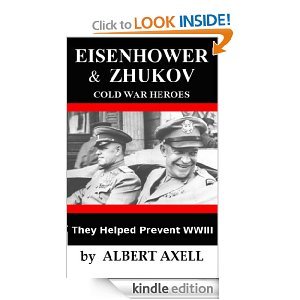
Eisenhower and Zhukov: Cold War Heroes
During the precarious decade of the 1950s when there was fear and loathing between the United States and the Soviet Union, there existed an...
Also Available in:
- Amazon
- Audible
- Barnes & Noble
- AbeBooks
- Kobo
More Details
During the precarious decade of the 1950s when there was fear and loathing between the United States and the Soviet Union, there existed an extraordinary friendship between President Dwight D. Eisenhower and Marshal Georgy K. Zhukov. This friendship was truly a Cold War phenomenon.The marshal had been Stalin's most brilliant wartime commander. The two became instant friends after the war. Most books about Eisenhower either fail to mention this bona fide friendship or dismiss it in a single sentence or paragraph. But there is evidence in these pages that the vigor of the Ike-Zhukov friendship, augmented by Eisenhower's eye-opening visit to war-ravaged Russia in August 1945, where Zhukov was his genial host, had a salutary effect on the way Ike viewed the Soviet Union.
During Ike's presidency he was continually surrounded by hawks who called for the extinction of Red Russia using hydrogen bombs. Instead, Ike was determined to avoid a nuclear confrontation with Moscow.
In mid-August 1958 senior United States Air force officers recommended dropping 10-to-15-kiloton nuclear bombs on targets in China in the event Beijing blockaded the straits between Taiwan and the Chinese mainland. But President Dwight D. "Ike" Eisenhower ruled out the nuclear option, according to a Pentagon document declassified early in the New Millennium.
At a Cabinet meeting called by President Eisenhower to discuss the threat of a Chinese blockade of Generalissimo Chiang Kai-shek's Taiwan bastion, Air Force General Nathan F. Twining, Chairman of the U.S. Joint Chiefs of Staff, gave his proposal on the magnitude of retaliation by the United States: "At the outset American planes would drop [nuclear] bombs on selected fields in the vicinity of Amoy", a coastal city on the Taiwan Straits now called Xiamen.
Hearing this proposal, "President Eisenhower simply did not accept the contention that nuclear weapons were as conventional as high explosives," according to a declassified Air Force history of the danger confronting Taiwan during the Cold War decade of the 1950s. In discussing the new document, William Burr of George Washington University's National Security Archive said Eisenhower's decision caused U.S. Air Force officials at that time to think more seriously about conventional warfare instead of focusing on nuclear arms.
An anomaly during that precarious decade was the existence of a genuine Russo-American friendship between Eisenhower and Marshal Georgy K. Zhukov who had been Russia's most distinguished military man in World War Two. There is evidence on these pages that the Ike-Zhukov friendship, augmented by Eisenhower's early postwar visit to Russia where Zhukov was his genial guide, was one of several factors behind Ike's decision to avoid a nuclear confrontation with China and the Soviet Union.
- Format:Kindle Edition
- Pages: pages
- Publication:2012
- Publisher:Amazon Digital Services, Inc.
- Edition:
- Language:eng
- ISBN10:
- ISBN13:
- kindle Asin:B009V7IWJE
About Author